
Water pooling in your yard or leaking into your basement is a massive headache for any homeowner. A French drain redirects this unwanted groundwater away from your foundation and landscaping, keeping your property safe and dry.
The success of this drainage system relies heavily on one crucial detail: how deep you dig. Excavation depth matters because it controls drainage flow and dictates how effectively the system prevents water damage. If you dig too shallow, the water will continue to flood your yard. Dig too deep without the right slope, and the water will just sit in the trench.
However, depth is not a one-size-fits-all measurement. It depends entirely on your soil type, the slope of your property, and the specific water problem you want to solve. Let’s break down how deep a French drain actually needs to be and what factors affect it.
What Is a French Drain and How Does It Work?
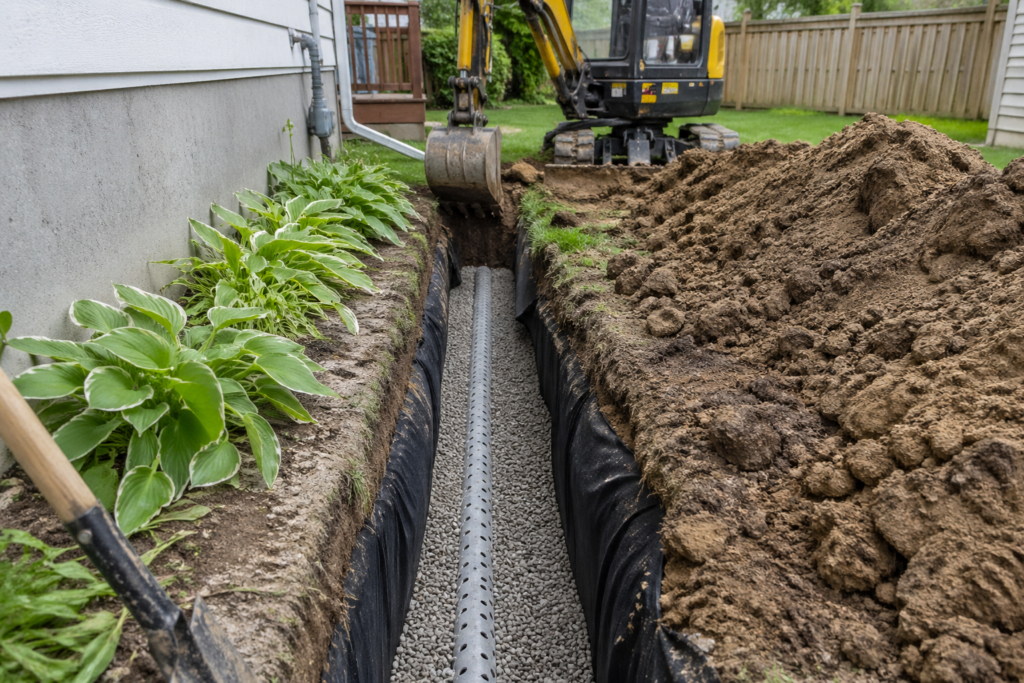
At its core, a French drain is a gravel-filled trench containing a perforated pipe. Its main job is to give surface water and groundwater an easy path to flow away from your home.
Water always looks for the path of least resistance. When groundwater saturates your soil, it enters the gravel trench and seeps into the perforated pipe. Gravity then takes over. The pipe is installed on a slight downward slope, allowing the water to flow freely toward a designated discharge point, like a storm sewer or a low-lying area of your property. Proper excavation is absolutely required to install this system, as the pipe must be buried at the correct depth and angle to work properly.
Standard Excavation Depth for a French Drain
The depth of your trench will vary based on the specific drainage issue you are trying to resolve. Deeper is not always better.
For standard residential yard drainage, the typical depth ranges from 12 to 24 inches. This relatively shallow depth is perfect for controlling surface water that pools on your lawn after a heavy rainstorm.
On the other hand, basement or foundation drains require a much deeper system. These trenches usually range from 18 to 48 inches deep, depending on the architecture of your home. You have to dig far enough down to intercept the groundwater before it has a chance to seep through your foundation walls.
How Deep Should a French Drain Be Around a Foundation?
When protecting a foundation, the golden rule of excavation is that the drain must sit below the problem water level.
For typical basement waterproofing, the trench should run along the footing level of the house, or slightly below it. By placing the pipe at this depth, you intercept the groundwater before it reaches the concrete walls. This requires careful excavation right up against the foundation. Removing the soil at this depth relieves the hydrostatic pressure that causes cracks, bowing walls, and basement leaks.
Factors That Affect Excavation Depth
Several unique site conditions will dictate exactly how deep your trench needs to be.
Soil Type
Different soils drain at different speeds. Heavy clay soil, which is very common in regions like Ontario, holds onto water and drains slowly. If your property has clay-heavy soil, you may need a deeper or wider trench to handle the slow water movement effectively.
Slope of Property
Gravity does the heavy lifting for a French drain. Flat properties often require deeper excavation at the discharge end of the pipe to create an artificial slope. Properties with natural hills might require less grading work.
Water Source
You must identify whether you are dealing with surface water or groundwater infiltration. Surface water issues only require shallow trenches to catch the runoff. Groundwater issues require deep excavation to pull the moisture out of the saturated earth.
Drainage Goal
Your end goal dictates the entire project scale. Fixing a soggy spot in the middle of your yard is a minor excavation task. Waterproofing a deep basement requires moving massive amounts of dirt to reach the foundation footings.
Minimum Slope Requirements Inside the Trench
Depth alone will not move the water. A French drain must slope consistently toward an outlet or a sump pump system.
The standard slope requirement is a 1% grade. This means the trench needs to drop about 1 inch for every 8 to 10 feet of length. If your yard is perfectly flat, you will have to dig progressively deeper as the trench moves away from your house to maintain this 1% grade. Slope matters much more than starting depth, because water will not flow through a perfectly flat pipe.
How Wide Does Excavation Need to Be?
Most residential French drains require a trench width of 6 to 12 inches. This provides enough room to place the perforated pipe and surround it with a thick layer of drainage gravel.
Wider trenches are sometimes necessary. Heavy clay soils often benefit from a wider gravel bed to collect more water. You will also need a wider trench if you are installing large commercial-grade pipes or dealing with exceptionally high water volumes from a large hillside.
Equipment Used for French Drain Excavation
Moving dirt is heavy work, and the right equipment makes the job significantly easier.
Mini excavators are highly popular for residential properties. They move dirt quickly while remaining compact enough to fit through standard backyard gates. For long, straight runs across a big lawn, a walk-behind trencher can slice through the dirt efficiently.
Hand digging with shovels is usually reserved for tight, delicate areas where heavy machinery cannot fit, or when digging closely around sensitive underground utility lines. Professional excavation teams know exactly which tools to use to improve accuracy and efficiency without damaging your landscaping.
Common Mistakes With Excavation Depth
A French drain will fail if it is not buried correctly.
Not digging deep enough is the most common error. If the pipe sits above the water table, the system simply will not collect the water. Conversely, going too deep without maintaining a proper slope causes water to pool inside the trench, eventually turning your yard into a swamp. Ignoring soil conditions and using poor backfill materials can also clog the system and render it useless within a few months.
DIY vs Professional Excavation for French Drains
Grabbing a shovel and digging a trench yourself might seem like a good way to save money. For small, shallow surface water issues, DIY is perfectly acceptable.
However, deep excavation carries major risks. Incorrectly calculating the slope will ruin the project. You also run the risk of striking underground utilities or causing structural damage if you dig improperly near your foundation.
Professional excavation offers distinct advantages. Experts calculate the proper depth accurately, utilize heavy machinery safely, and ensure long-term performance. Getting the slope and depth right the first time saves you from having to dig up your yard twice.
Cost Impact of Excavation Depth
The depth of your trench directly impacts the final price of the project.
Deeper excavation requires more labour, larger equipment, and increased costs for hauling away the excess dirt. Your soil type also affects the cost, as hard clay is much more difficult and time-consuming to dig through than loose sand. Finally, accessibility issues—like tight spaces between houses or complex landscaping—can drive up the cost because the crew has to work slower and rely on manual labor.
Securing a Dry Future for Your Property
There is no single magic number for how deep a French drain should be. It depends entirely on your site conditions, your soil, and the specific purpose of the drain. Shallow trenches work great for lawn puddles, while deep trenches are mandatory for protecting a basement.
Proper excavation is the foundation of long-term drainage success. If you’re dealing with drainage or foundation issues, professional excavation ensures your French drain is installed at the correct depth the first time. Reach out to a local drainage expert today to protect your property from water damage.